
FROM ROB'S BENCH
Traditional furniture making details

Rob Brown
Blog for May 1, 2025
Once in a while I'll agree to help a client with fixing up an old piece of furniture they have.
It usually involves fixing a few of parts, repairing some chipped veneer, strengthening a door or drawer and making sure the hinges are going to hold the amount of weight they need to in order for the piece to function as it should.
I don’t do this sort of work too often, but looking back on all the pieces I’ve worked on, I’d have to say the pieces made entirely from solid wood aren’t made with the same care as the pieces made, at least in part, from veneer. Don’t get me wrong; I’m not saying a piece of furniture that includes a fair bit of veneer work is always better than a piece made entirely of solid wood. I’m guessing there are many poorly veneered pieces out there, but they might not last 20 years before they get tossed into the landfill, rather than the owner wanting to have them fixed.
Veneer is unique
Veneering requires a bit of a different mindset than working with just solid wood. There’s much more that goes into making a top, for example. Core choice is first, with solid wood cores, as well as today’s options of plywood, MDF and particle board, being the main choices. I’ve only made one solid wood core, veneered panel, and that was in college, about 30 years ago. That top is still in use today at my mother’s home and it looks almost as good today as it did right after I applied the final coat of lacquer to it.
The piece I’m working on right now is an old Singer sewing machine. My client wants to have the ability to place a nicely-made top on top of the sewing machine when it’s not in use. Luckily, she had an extra table leaf from a mid-century modern table she didn’t need, so I’m adapting that to fit on top of the sewing machine.
Layers make it work
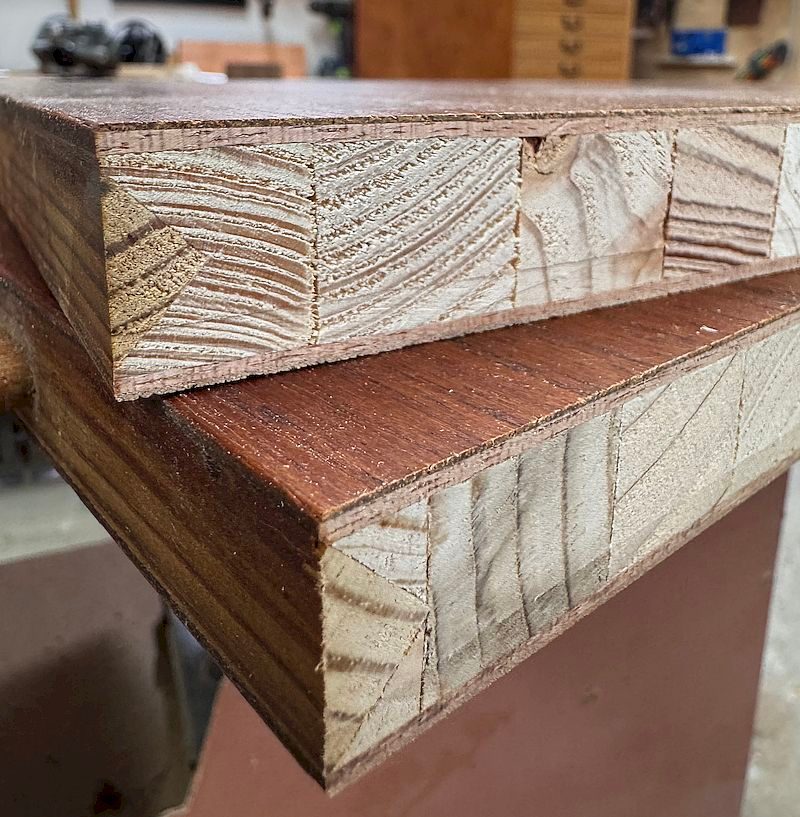
The table leaf has a solid wood core, made of laminate strips of pine. Crossbands, which are layers of veneer adhered to both surfaces of the core, and with its grain rotated 90 degrees to the grain of the core, has been applied to the core. It’s thicker than most veneer, at a healthy 1/16″ thick. Face and back veneers are applied to the top, on top of the crossbands. The grain of these veneers is rotated 90 degrees to the crossbands, or parallel with the solid core top.
The crossbands keep the solid core from moving. They also limit telegraphing of the joints that make up the solid wood core. Telegraphing is when joints underneath the outer veneered surface move or shift and show through the face and back veneers, causing unsightly lines. Thick crossbands like these do an even better job of stopping telegraphing than standard veneers that are about 1/32″ thick, at most.
Knowing how a panel is made often helps me determine how I’m going to work with it for a client and ensure I get the best results for them.
Screw it
I’ve also noticed over the years that screws have come a long way over the past 50 years or so. Screws used to be stubbier, with threads that had less depth. Threads of older screws also seem to be closer together, meaning less wood is between each thread once the screw is driven in. All this adds up to less strength. It also reduces the number of times a screw can be removed before it gets too weak, as the small amount of wood between the threads gets damaged. Usually, I will only remove an old screw if I really need to, as I don’t need to cause more work for myself. On top of all this, I find if an old screw is tightened even a tiny bit too far, it quickly damages the small amount of wood material between the threads. In all, I hate old screws, even if they look good when you can only see their heads. In my books, the patina of old screws is about all they have going for them.
What about you?
Many things in the furniture construction world have improved over the last 50+ years, but certainly not everything. I guess we have the ability to make a very well-made piece of furniture now, but many folks don’t want to pay for it. Quality furniture takes time, and in turn, money. You’ll still see many older pieces of furniture around today, as just about every family has some sort of heirloom piece passed down from generation to generation. It’s up to us woodworkers to do a good job at repairing these pieces so they can last another generation, or more.
Have you taken apart an older piece of furniture and noticed how construction, joinery and hardware has changed? Let me know in the comments section, below.
Veneering Techniques
Here, a solid wood core has had a thick crossband applied to either one of its faces, but with its grain rotated 90 degrees. Next, face and back veneers, which are usually thinner than the crossbands are applied to the faces, with their grain running now parallel with the core's.
Traditional Veneering Techniques
Solid cores, with thick crossbands, are a staple of older, well-made furniture.
Other Interesting Details
Older screws are much different than newer screws. I'd say we're lucky to have newer screws, with more holding power.

Really enjoyed this note on older furniture. My house has many antiques which my kids don’t care for but my wife and I still love. Much as I like Canadian Woodworking, there is not much time spent on repairing, rebuilding or refurbushing antiques or just old stuff. And I appreciate Rob’s comment on feeling an obligation to keep the older furniture in a good state of repair. Thanks for this. Would enjoy seeing more.