

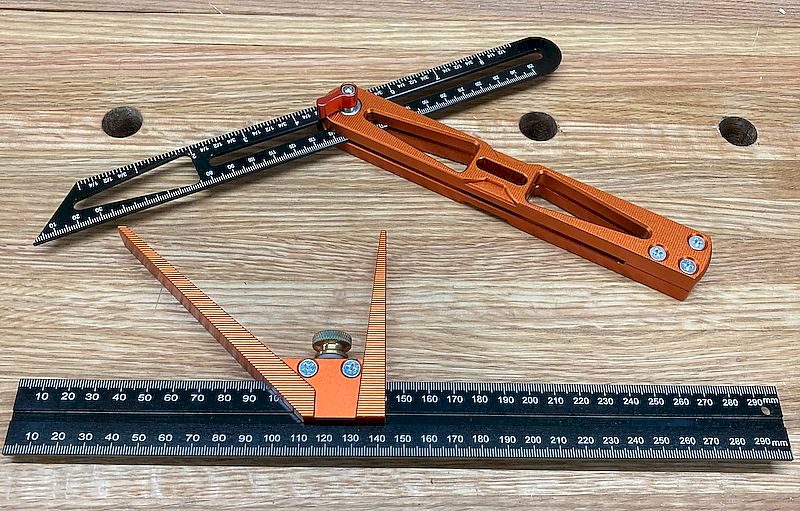
A good quality set with the durability to stand up to any conditions you may put it through.
The new line of Whisky Jack precision tools is available through Canadian Woodworker, who have specialized in the sale of machinery and tools for the woodworking industry in Canada for over 55 years. Based in Western Canada with 4 locations and online retail shop, they pride themselves on their expertise and vast range of offerings.
Manufacturer: Whiskey Jack
Model options:
WJ Precision Square & Angle Tool Set: $199.95
Wheel Marking Gauge: $49.95
Mini T-Square: $49.95
Bench Dog Fence Kit: $89.95
Fret Saw: $89.95
Thin Rip Table Saw Jig: $69.95
Source: Where to buy
My first impressions of the Whisky Jack line were simply Excellent Packaging! It is obvious a lot of care and thought was put into the packaging, making any rough and tumble shipping experience, something of little concern. Right out of the box these precision tools are ready to go and in pristine condition.
The tools themselves are very nice looking with their bright orange and chrome combination, they’re certainly something that would look great on any tool bench or in any shop. On top of which they stand out, you’re not going to lose these any time soon in the clutter a benchtop often accumulates. The colour selection also makes all of the markings and precision measurements and details very easy to read.
While I didn’t review every item, I did have the chance to test a number of them and here’s my two cents on each of those:
Fret Saw
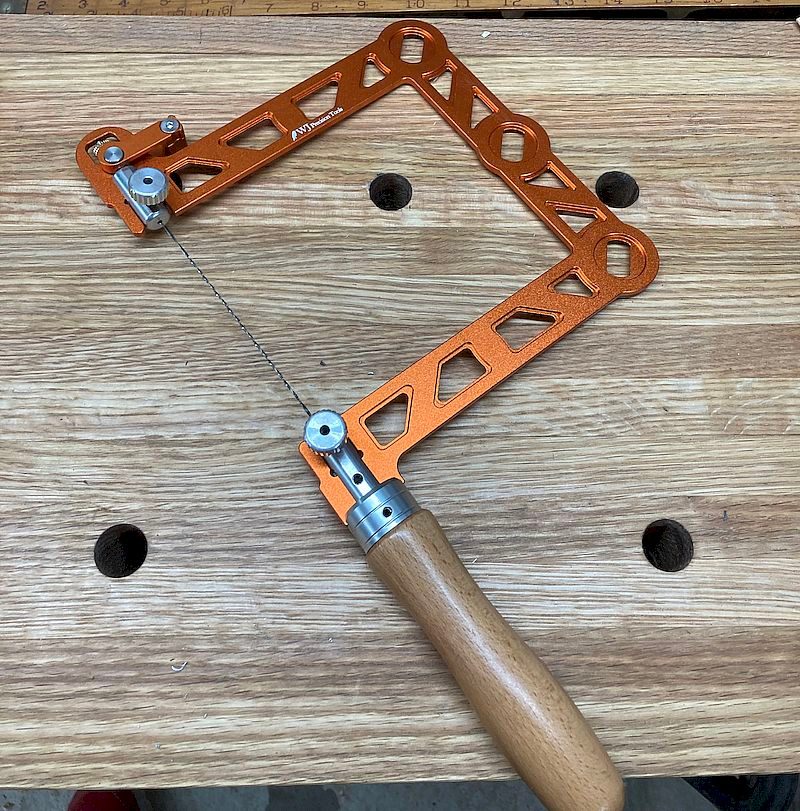
First and foremost, with any fret saw I’ve ever used, the handle by far is one of the most important aspects, if it doesn’t feel comfortable in the hand it simply isn’t a tool you’d want to use. Believe me, I’ve used fret saws that make you wonder how on earth they ever passed quality control. Thankfully the Whisky Jack Fret Saw handle is made with a quality beech, it’s smooth and a comfortable fit in the hand. With a 5” deep cut, it provides plenty of working space to make those fine, accurate cuts you need. Adjusting and tensioning the blade is perfectly simplistic in its design and changing the blade is a quick and simple matter, which as we all know, when you’re dialed into a project, dealing with replacing blades is not something you want to be doing.
Bench Dog Fence Kit
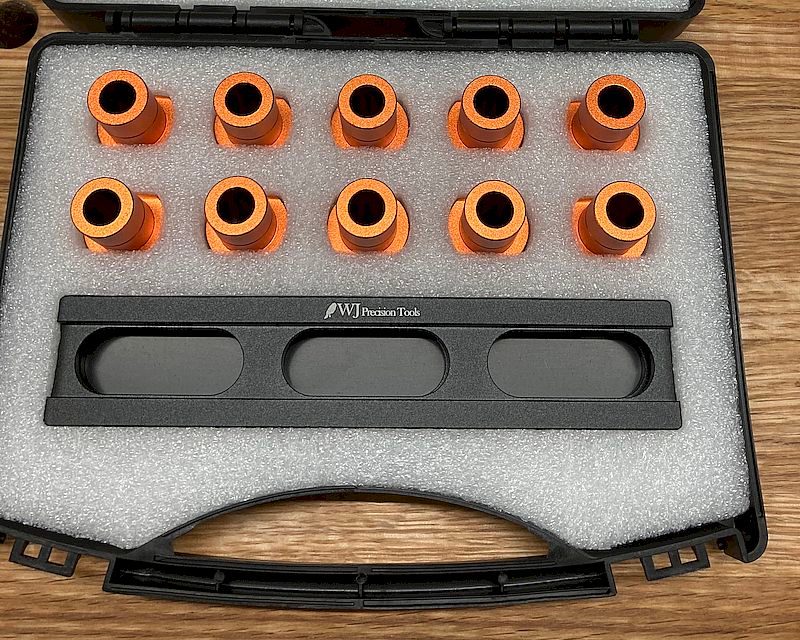
I am really impressed with this, I built a hand tool bench earlier in 2025 with ¾” dog holes, and I really had no intention of using a kit like this so when planning out the spacing it was designed to my own specifications, nothing else. Yet the Whisky Jack Bench Dog Fence Kit works perfectly, the dogs fit snugly and are low profile, the fit into the rail system is secure and it offers a great way of holding your work. Each dog comes with anti-slip padding on the top and are great for raising a piece up off the bench and being held secure while doing things like finishing. The dogs are an oblong shape so when seated in the fence they hold snuggly and provide a solid yet adjustable planing stop.
Wheel Marking Gauge
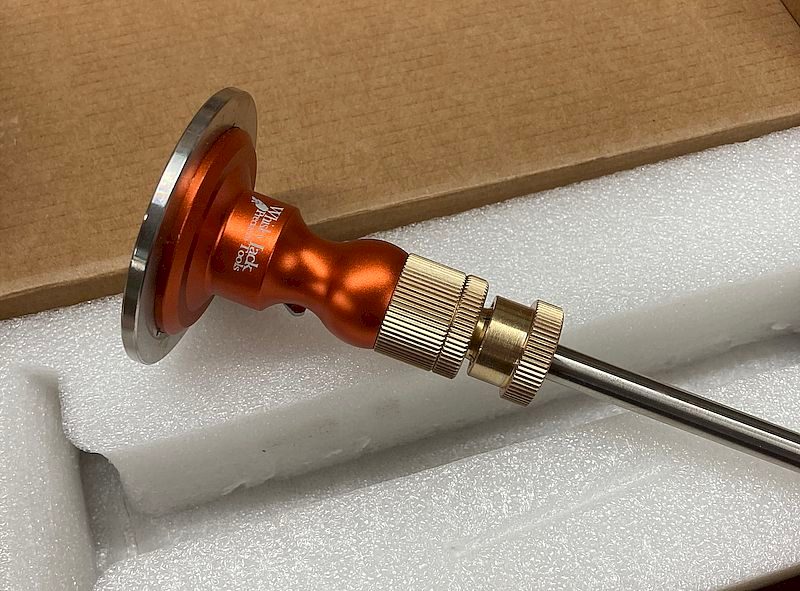
I absolutely love the micro-fine adjustment, you can really dial it in so precisely you have to question the level of accuracy other models truly provide. One little issue I do have is the fence wheel, is it’s quite large, so while it gives a fantastic reference surface on the edge of the work piece, if your piece is less than 1” thick the wheel will come in contact with your bench surface and could throw off the accuracy. Now in my case, I just moved the piece to the edge of the bench so the wheel had complete clearance, however, if you don’t notice that right away, it could potentially throw off your measurements. All in all the overall make and quality of the Wheel Marking Gauge is fantastic, it is finely crafted and takes accuracy to a new level.
Thin Rip Table Saw Jig
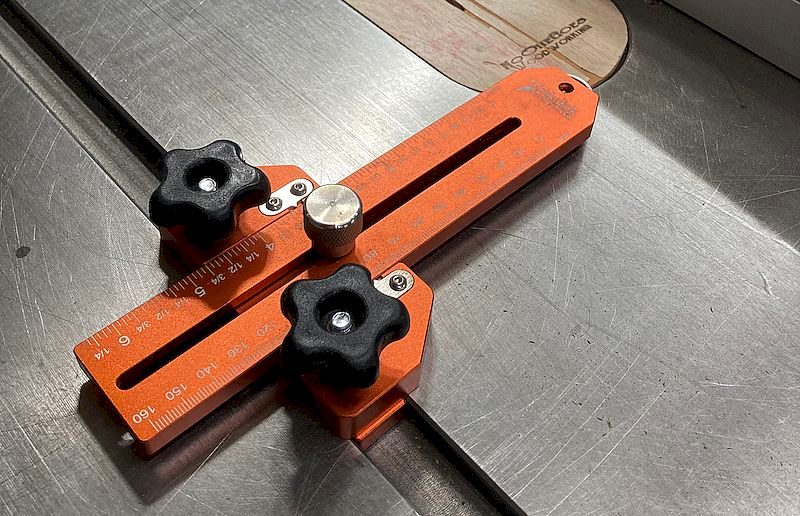
This was something I really wanted to try out! The number of times our team has discussed the millions of ways to rip thin strips is honestly kind of shocking. Somedays it seems we’ve analyzed every opinion, jig, safety feature, and old folksy wisdom from top to bottom on what’s truly the best method. So far, the answer is…whatever works best for you, as long as no one gets hurt!
Personally, for the longest time I simply moved the fence up as tight as I needed to the blade and sacrificed my push stick, which would ultimately become firewood the more times I used it. It wasn’t a perfect solution, but it works, and that’s why my push sticks are made of scrap plywood, they’re meant to have a finite life span.
The Whisky Jack Thin Rip Table Saw Jig acts like a feather board. Once dialed into the right distance from the blade to give you the thickness you want, you tighten it down into your mitre slot, butt the piece up to it and set your fence, then off you go. Yes, you have to adjust the fence each time but having the thin piece on the outside of the blade rather than between the blade and fence makes for a far safer fall away, as well as means those push sticks will live to see another day. All in all, I’ve really enjoyed using it and really look forward to using it some more very soon.
Mini T-Square
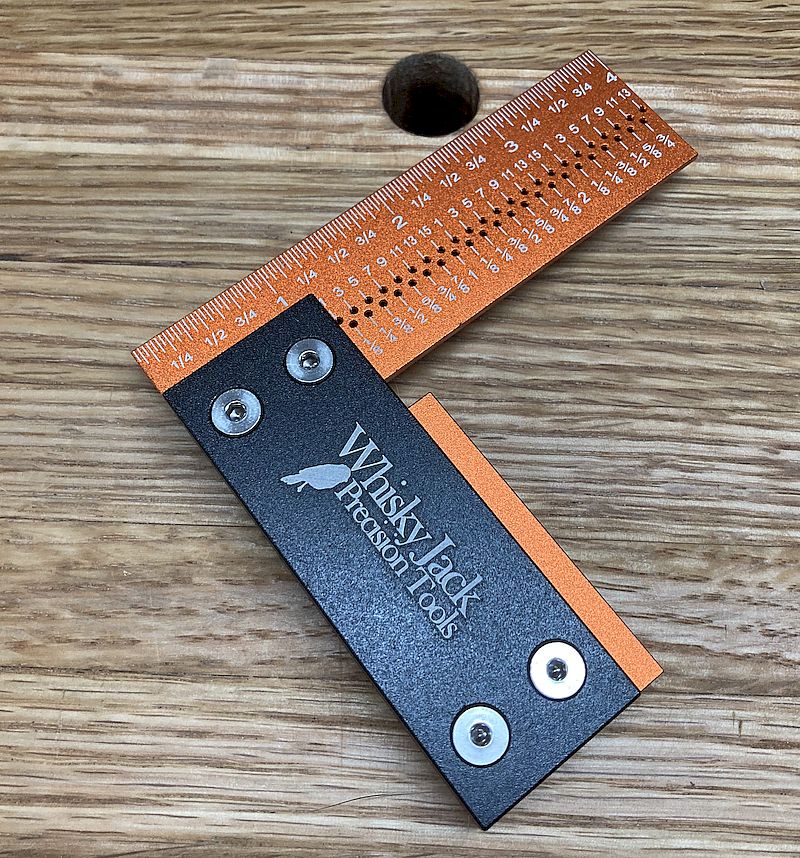
I don’t know what it is about smaller layout tools, but I have to say I’ve always been partial to them. The sheer convenience of being able to tuck it into an apron pocket and have it readily available at any time has always appealed to me. The Whisky Jack Mini T-Square meets that appeal and then some. The level of detail and accuracy in the engraved body are clear and precise. The layout holes are placed in 1/16” increments making for excellent accuracy in your layout marking and proves very useful when laying out joinery.
One note, however; as with any square I always check it to my engineers’ square and I did find it slightly out of square. But by slightly out, I mean a fraction of a hair of a degree, so minute that after a slight adjustment it was perfect within seconds and I was off and running with it. I do fully expect this is going to be one of my absolute favourite tools in the shop moving forward now.
WJ Precision Square & Angle Tool Set
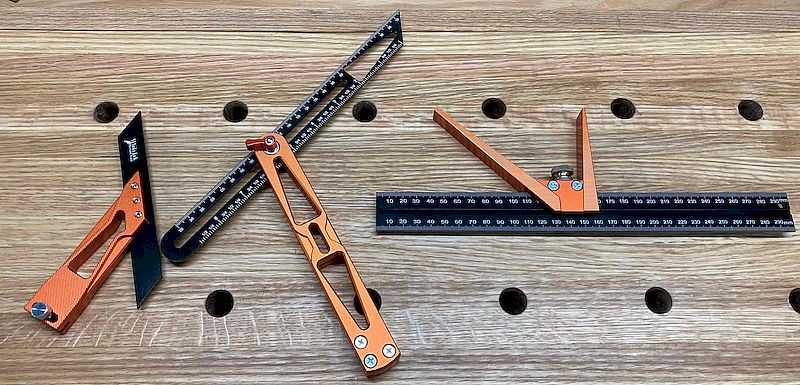
For a very long time I’ve used an angle finder that’s probably over 100 years old, likely much older, and it’s done just fine. I’ve had to be a little creative to get a spot on-exact angle, but it never failed me. However, one concern I’ve always had with it is that uncertainty of setting it down and accidentally being knocked into, losing that set angle I had. I’m sure that’ll always be a slight concern in the back of my mind but the locking mechanism on the Whisky Jack Angle finder provides a remarkably secure hold. The Whisky Jack Angle Tool is 2 tools in one, it’s an angle finder (and includes common angle markings for quick reference), and it’s a folding ruler with both imperial and metric, combined with the Combination Square and the Angle Ruler, the set offers a ton of versatility when it comes to marking and measuring your work.
The combination square is simplistic in its look and design, the biggest positive like all of the Whisky Jack layout tools is how clear and easy to read the laser etched markings are. The silvery/white on a black background never makes you second guess your eyes. Like the Angle Finder it includes both imperial and metric markings.
Overall, while I didn’t test out the entire Whisky Jack line, you can see what else is offered on their website, I found everything to be of excellent quality. I perhaps mentioned this too often, but the clean and precise measurement markings make for easy readability in any type of lighting. The quality is noticeable right from the beginning, there has been a lot of care and thought put into the tools right from the packaging to the durability to stand up to any conditions you may put it through. Other items in the line include a variety of router and joinery jigs, alignment and precision gauges etc. Absolutely worth looking further into and seeing for yourself.




Nice (and familiar) looking tools. Whiskey Jack head office is in Winnipeg. Are the tools made there or ?
Hi Jim: As with many modern tool brands, these tools are manufactured overseas, which helps keep prices accessible for hobbyist woodworkers. Quality control has also improved significantly compared to a decade or two ago.