
FROM ROB'S BENCH
Straight from the bottle?

Rob Brown
Blog for December 4, 2025
If you've been a woodworker for more than an hour, you know glue plays a huge role in the craft.
Laminating narrow boards to make a wider panel and gluing joinery to help produce strong, lasting joints are two of the most common activities in woodworking. You’ll also likely know glue-ups can be tense moments that can make or break a project.
At its very simplest, it involves squeezing some glue on the surface you want to bond to a mating piece, wiping that glue around that surface with your finger, possibly doing the same for the other mating surface, then bringing the two parts together and putting a clamp across the joint until the glue cures. Speed, the desire to not get splinters and the need to get glue into corners and other tight spots might mean you use a roller or small brush to help spread the glue. It’s all pretty simple, really.
A dish?
I’ve been working wood for almost 35 years. I’ve spent a decent amount of time in about a half dozen professional workshops. I’ve only seen this simple glue-spreading approach used. I’ve never been beside anyone who puts the glue into a small dish or cup, then uses a brush to transfer that glue onto the workpiece.
I’ve also had the opportunity, via social media, to peer into thousands of other woodworking shops. The vast majority seem to employ this common but simple glue-to-workpiece approach. Having said that, I do come across the odd (and I do mean odd!) person who feels the need to make gluing even more complex than it already is. These woodworkers have introduced a glue dish into the process. One of these odd folks may very well be a regular Canadian Woodworking & Home Improvement contributor who had the nerve to get the exact same haircut as me and even wrestled a few cover stories out of my hands over the past few years. Time will tell where this character sides on this topic.
I’ve never felt the need to put glue into a dish, then use a brush to spread it on the workpiece. In some sort of strange way, using a dish looks more refined that just squeezing glue directly out of a bottle onto the workpiece, but I can’t really put my finger on why I feel that way.
Time to try it
The other day I was gluing up a simple sandwich board for a friend of mine who owns a local business in my town. It wasn’t a complex glue-up. I noticed a small dish sitting right beside the glue bottle, so I thought I’d finally try it out. Don’t know until you’ve tried it, right?
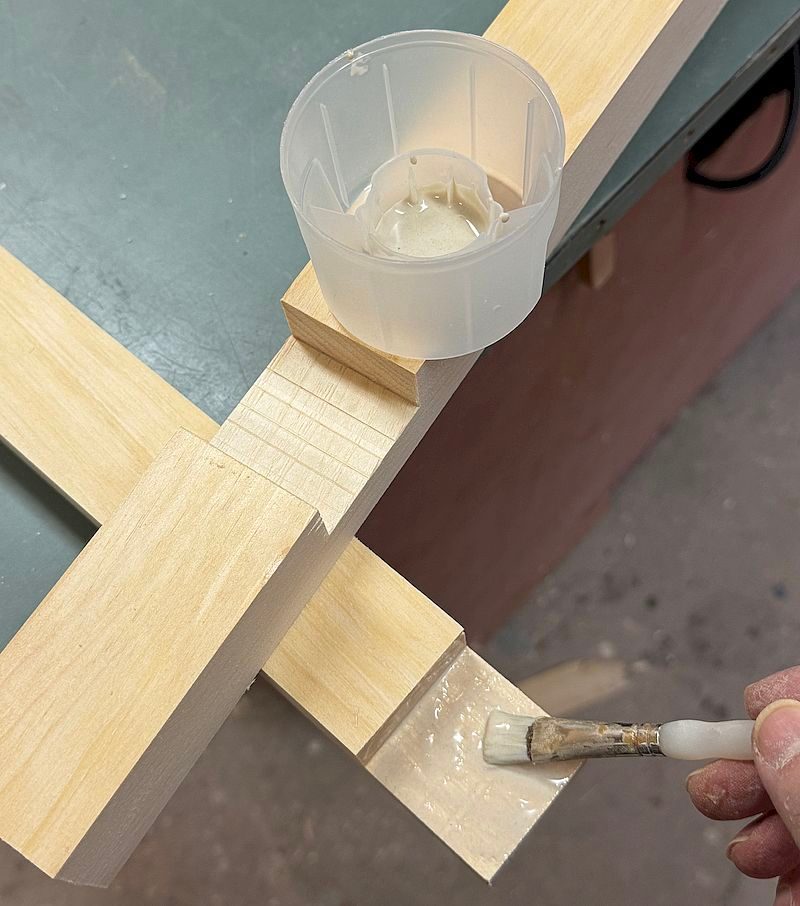
I put some glue into the dish, grabbed a small brush and got to work. I applied glue to the surfaces of some half-lap joints and brought the parts together. All went fairly well, but I didn’t yet see any benefit to adding the glue dish to the process. In fact, if anything, the dish was harder to hold onto than my glue bottle, but not by much. And if I just set the dish down on the worksurface, and dipped the brush into the dish, the adhesion of the brush to the viscous glue was quite high, causing the dish to be lifted off the table while I pulled the brush out. Not overly fun.
So far, not awful
With the first half of the sandwich board complete, I readied the pieces for the next assembly. While applying glue to the first lap joint with a brush, I dropped the dish and lost a small amount of glue on my assembly table. Not a big deal, but it just added to the mess and increased my anxiety levels ever so slightly. I picked up the dish, only to be left with glue all over a few of my fingers, as I didn’t realize some glue was on the outer surface of the dish. Again, not a big deal, but I had to wipe it off on my apron so I wouldn’t leave glue fingerprints everywhere.
I guess I wasn’t successful, as within a few seconds of handling the parts I realized I was leaving glue marks on the freshly sanded wood. Again, not a huge deal on this outdoor project. I can re-sand those surfaces later, before I apply a finish.
I got about half way through the process, then realized I didn’t have enough glue to finish the task. Thankfully I didn’t have to rush, as this was a simple assembly. I reached for the glue bottle, squeezed more glue into the dish, then went about my way.
Fairly quickly, I wrapped up the second assembly, only to notice a half decent amount of unused glue in the bottom of the dish. Very few woodworking materials are cheap these days, and glue is no exception. This was likely only about ten cents worth of product, but I still didn’t like the idea of wasting it. But what should I do with the extra glue? Putting it back in the bottle isn’t quick, as the lid of my glue bottle gets stuck to the bottle. I often need a pair of slip joint pliers to get the lid off. And in my shop, time is money. All of a sudden, I found myself doing a time vs overhead cost comparison in front of my little dish of glue. This was crazy, I thought to myself.
Final verdict
After deliberating for about two seconds, Judge Brown quickly handed down his decision. Guilty on all counts: wasting time; wasting money; leaving glue stains on freshly sanded wood; and increasing anxiety during possibly the tensest part of woodworking. Straight to jail.
The court of public opinion is still in session, though, so feel free to leave your thoughts on defending the lowly glue dish if you feel it still has a place in our society. It will take a miracle for this woodworking judge to give the glue dish a second chance. Using a glue dish may look refined, but it’s nothing but a woodworking criminal.
Glue Dish
Things were going smoothly, until I was five minutes into the glue-up. That's when all the shortcomings of the glue dish became apparent. This project made it out alive, but just by the skin of its teeth. The glue dish went straight into the trash.

couldnt agree more
straight from the bottle on to the work piece
Like others commenting, I too tried the little dish with glue and brush. A very large project re-gluing a water damaged pool table railings. I quickly learned that a glue bottle with a long spout and a brush works just fine. The little dish ended up in the trash.
I often make small projects, like toys and picture frames. For those I keep a small glass container with a tight lid on my bench. The container is refilled as needed, and there is no waste. On bigger projects I use a bottle like everyone else. I guess it’s like the old saying, the right tool for the right job.
I depend on both at different times.
Directly from the bottle onto a straight run of glue (or large face-glued zone.)
And onto a small flat scrap (rather than a cup) when I need to work glue into small, sensitive joinery.
But you are right, Rob – one size does not fit all.
After reading your escapade I am going to stay with using the bottle to apply glue. Thanks for your experimenting.
Glue dish , I tried it once and I came to the same conclusion as Rob.
In the trash went the dish!!!
My pet peeve with straight from the bottle is having to shake the glue from the bottom of the bottle to the spout for each subsequent joint. I store my glue upside down so the glue will deliver instantly on the first joint once the cap is removed.
The only time I use a dish is when I use epoxy (A & B). The dish will eventually get tossed as the glue hardens. But for the same reasons you cited, I avoid epoxy just because the little dish is a pain.
I can see a couple of cases where using a dish would make sense:
1) If you need to thin the glue to make it run into a tight crack. I learned that from luthiers on YouTube and have done it myself when gluing cracked wood for shelving.
2) If you need to apply glue to the bottom of something. I used a dish & brush while trying to re-laminate the bottom edge of a water damaged plywood cabinet (i was standing on end) and the bottle couldn’t squirt glue upward. I ended up turning the whole thing upside down, cutting the damaged parts off and replacing them but that wasn’t the dish’s fault 😉
I have done it, and I am totally with you brother. If something seams wrong with what you are doing and it is not the way you always did it, don’t change.