
Drum sanders are a quick and efficient way to sand large panels save you hours of sanding by hand.
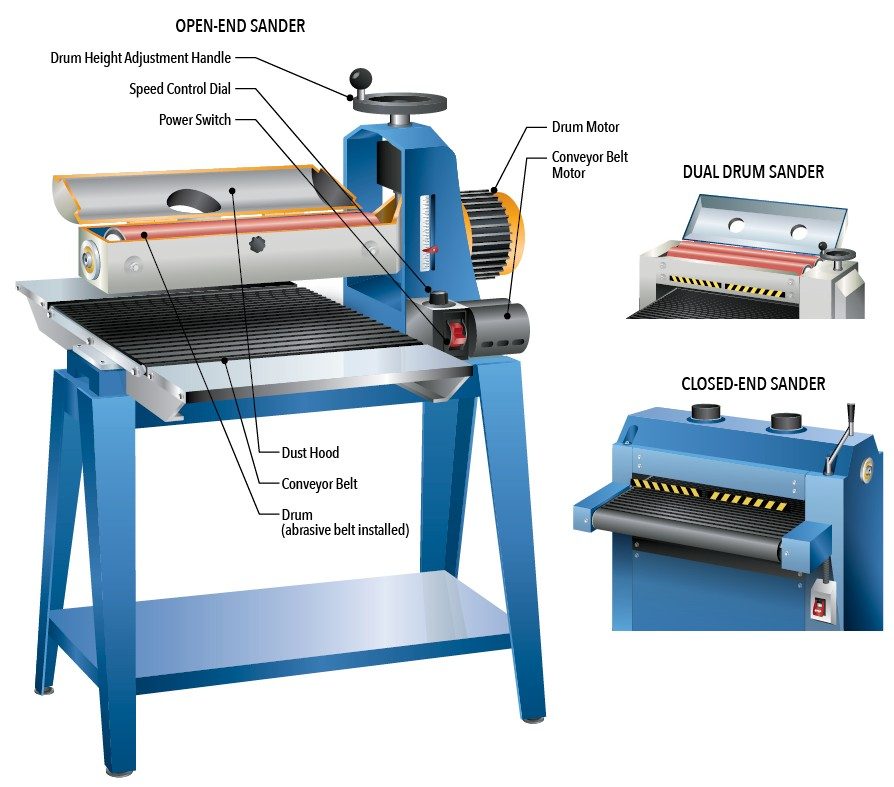
There are three basic types of drum sanders: closed-end, open-end and dual drum sanders.
Closed-end drum sanders have a rigid frame that supports the drum on both sides. The maximum width capacity ranges from 12″ to 50″. They offer excellent stability and are a popular choice for professional woodworkers.
Open-end drum sanders, supported on only one side, allow you to sand pieces wider than the drum by flipping them and making a second pass. This flexibility makes them suitable for wider tabletops or large cabinet panels. The open design can flex slightly under load, so even pressure and careful alignment are essential to achieve consistent results. These sanders are very popular with both hobbyist woodworkers and professionals.
Dual drum sanders feature two sanding drums arranged in sequence, typically with progressively finer grits (such as 80 and 120). This setup removes material and smooths the surface in a single pass, improving efficiency and finish quality. These machines are larger, more expensive, and best suited for advanced users, professional woodworkers or small production shops that process high volumes of work.
Choosing the right type of drum sander depends on your typical project size, workspace and budget. Each type offers distinct benefits, from compact reliability to professional-level productivity.
Power: 2 – 5 HP
Feed speed: 2 – 15 FPM
Thickness capacity: 3″ – 12″
Width capacity: 12″ – 37″+
Illustrator: Len Churchill
Get the Most Out of Your Drum Sander
Take light passes
Drum sanders are designed to refine surfaces, not remove lots of material. Trying to take off too much in a single pass can cause burning, overload the motor and wear out your abrasives faster. Stick to light, consistent passes to maintain surface quality and prolong the life of your machine.
Use the right grit sequence
Start with a coarser grit (e.g., 80) to flatten or level a surface, then work your way up in increments (e.g., 120, then 180) for smoother results.
Keep abrasives clean
Use an abrasive cleaning stick or compressed air to clean the drum regularly, especially during long sanding sessions. Replace worn paper as soon as it loses its bite.
Support long workpieces
Use infeed and outfeed support — roller stands or tables — to keep large panels level as they move through the machine. This helps reduce uneven sanding or snipe at the ends.
Monitor heat and feed rate
Reduce feed rate if the sander struggles or increase it slightly if you see burning. Let the machine and the abrasive do the work at a steady pace.